Essay
Emma and Harriet: A Sapphic Reading of Jane Austen's Emma
A thought experiment about Jane Austen's Emma, queer reading, and the freedom of the unknowable character.
Near the end of Emma, once everybody has been safely engaged to the correct person, Austen quietly disposes of the friendship that drove the entire novel. Harriet is going to marry Robert Martin and move to Abbey-Mill Farm, and Austen writes her off in a single administrative sentence: The intimacy between her and Emma must sink; their friendship must change into a calmer sort of goodwill. A few words earlier she notes that Harriet was less and less at Hartfield, which was not to be regretted.
It's an odd note to end a comedy on. Everyone has got what they wanted, and the price is that these two will now see rather less of each other. Austen is tidying up. But she is tidying up something she has spent four hundred pages making enormous.
That's where this starts. Not was Emma secretly a lesbian — I'll get to why that question is a dead end — but: what happens to that attachment once the marriage plot has finished using it?
Disclosure: As an Amazon Associate I earn from qualifying purchases made through links on this page.
What's actually on the page
Emma picks Harriet up more or less the way you'd pick up a stray. Austen introduces her as the natural daughter of somebody: illegitimate, boarding at Mrs Goddard's school, pretty, pliable, and nobody's particular business. Emma makes her her business.
The programme is announced almost immediately, and it's worth quoting because of the tense: she would notice her; she would improve her; she would detach her from her bad acquaintance; she would form her opinions and her manners. Four verbs, one object.
She paints Harriet's portrait and — by her own admission — gives the figure a little more height and considerably more elegance than the original, which Knightley notices and says out loud: You have made her too tall, Emma. She has Harriet at Hartfield so constantly that Harriet ends up with a bed-room appropriated to herself, which is not a guest arriving but a person accommodated. Harriet kisses her hand. Emma vets Harriet's suitors with an attention that would be excessive in a mother and is frankly deranged in a friend of twenty, and the refusal of Robert Martin's proposal is, let's be honest, Emma's refusal with Harriet's signature on it.
A caveat I'd rather raise myself than have someone raise for me: the physical evidence here is thinner than the queer-reading tradition tends to suggest. People will tell you Emma and Harriet walk arm in arm. They don't — not once in the book. Emma walks arm in arm with Jane Fairfax, the woman she spends three volumes being cold about. The hand-kiss happens in silent and submissive gratitude, which is a servant's register, not a lover's. Whatever is going on between these two, it isn't happening at the level of touch. It's happening at the level of property.
Then there's the matter of what Emma sounds like when she thinks she's lost her. When she finally works out that Harriet is in love with Knightley, Emma doesn't produce one of her elegant self-corrections. She produces a wish that she had never laid eyes on the girl. It's the closest thing to a howl in the entire novel, and it isn't about Knightley.
Set all that against the other thing Emma is doing in those same early chapters: explaining, at length and to Harriet specifically, that she has no intention of marrying. She doesn't need the fortune, the employment or the consequence — she has all three. She's already living the life she wants. And the thing she's adding to that complete life, in the same breath as she declares it complete, is Harriet Smith.
Why proving it is a trap
Here's where this sort of essay usually goes wrong.
Every item on that list has a perfectly ordinary period explanation. Regency women wrote to each other in the language of courtship, shared beds without anyone reaching for a magnifying glass, walked arm in arm through market towns, and were socially encouraged to adore one another in public. In 1995 Terry Castle wrote a piece for the LRB — reviewing Deirdre Le Faye's edition of the letters, and titled, mildly enough, "Sister-Sister" — suggesting that Austen's correspondence with Cassandra ran warm. The magazine put "Was Jane Austen Gay?" on the cover, and the letters page burned for months afterwards, with Castle protesting that she had said nothing of the kind. Which is instructive: the moment a reading of this sort acquires a headline, it stops being a reading and becomes a verdict people feel obliged to appeal. The evidence is real; the inference is unprovable; and once you start assembling the case, you've stopped reading and started prosecuting.
There's also the small matter that Emma is a snob, a control freak and a serial arranger of other people's lives, and that "possessive of Harriet" is entirely consistent with "has decided Harriet is her project." Emma Woodhouse does not undertake projects casually.
So: we can't settle it. Good. I don't want to settle it. Fiction built to win an argument is usually terrible fiction, and a novel whose job is to reveal that Emma was Really Like That All Along is a novel with a thesis where its heart should be.
What Austen has given us is more useful than proof. She's given us a history. Two women who already know what it is to seek each other out, to touch without thinking about it, to share a house and a routine, to notice an absence. A sequel wouldn't have to build any of that. It would only have to put them back in the same room and see whether the old shape still fits.
Twenty years
Harriet marries Robert. Emma marries Knightley. Both marriages are happy — genuinely, unironically happy.
That part is non-negotiable, and it's where most versions of this story fall over. The temptation is to turn the husbands into errors that the women eventually recognise and correct, which is both bad manners and bad plotting: it makes twenty years of two lives into a waiting room. Let Emma love Knightley. Let Harriet love Robert. Let the children arrive, the harvests come in, the parish do what parishes do.
Then bring Harriet back to Hartfield. Widowhood, if you like. A long visit that was only ever meant to be a short one. The machinery is the least interesting part of the whole idea; you could sort it in a paragraph.
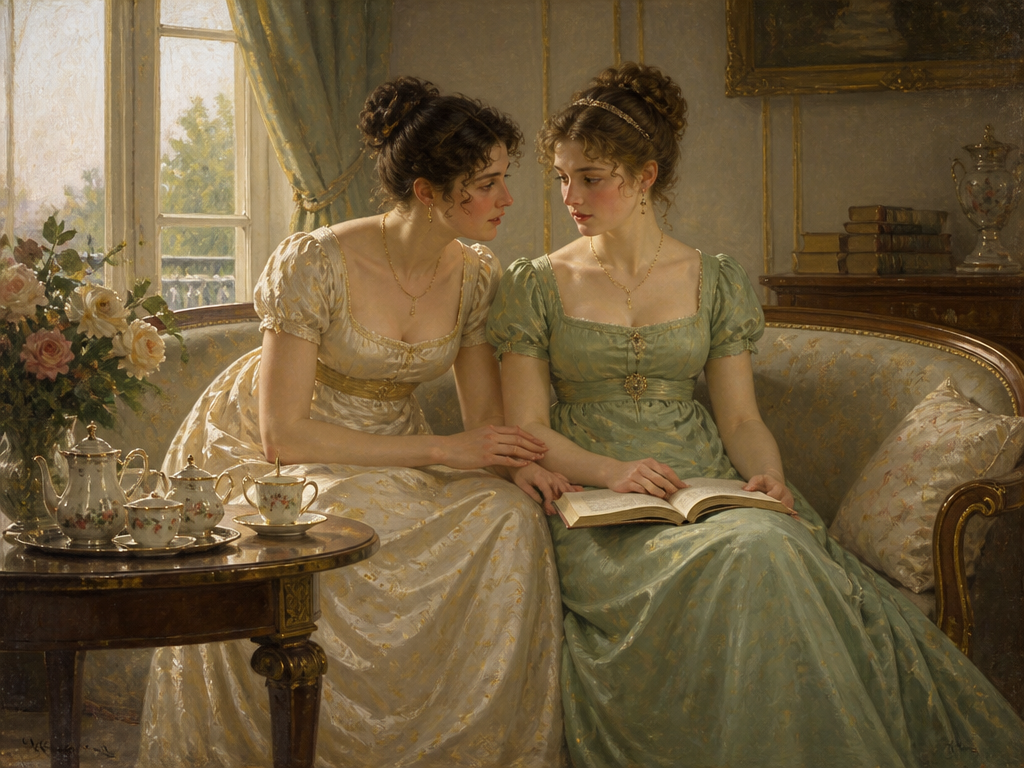
What matters is the arrangement. Two women who once shared a house and a daily life are sharing them again — but not as Miss Woodhouse and her dazzled seventeen-year-old. As equals, each with twenty years of separate weather behind her.
And the habits come back before anything else does. That's the thing I'd want to get right. Not longing — habits. A walk after dinner because there was always a walk after dinner. Two books left open in the same room. Emma rearranging something that did not need rearranging. Harriet staying another week, then another, and neither of them quite raising it.
Nothing happens for a long time. Then it has.
It has to be Harriet's book
The point of view is the real problem, and also the real opportunity.
Emma's consciousness is one of the most thoroughly rendered in English fiction. Austen built the machinery of free indirect discourse practically to house it. You cannot borrow that interiority without making rulings — every thought you hand Emma is a verdict on what she felt in 1815, and the moment you deliver that verdict, the ambiguity that made the whole thing interesting is gone. You've written the prosecution's closing statement after all.
Harriet, on the other hand, is a hole in the book, and a very inviting one. She's illegitimate, biddable, and almost entirely refracted through Emma's judgement of her. We never learn what she thinks about God, money, her own body, or being managed. We know she once kept a stub of pencil and a scrap of court-plaister in a parcel labelled as her most precious treasures, and then burnt them. That is a woman with an inner life, and Austen shows us exactly one glimpse of it before closing the door.
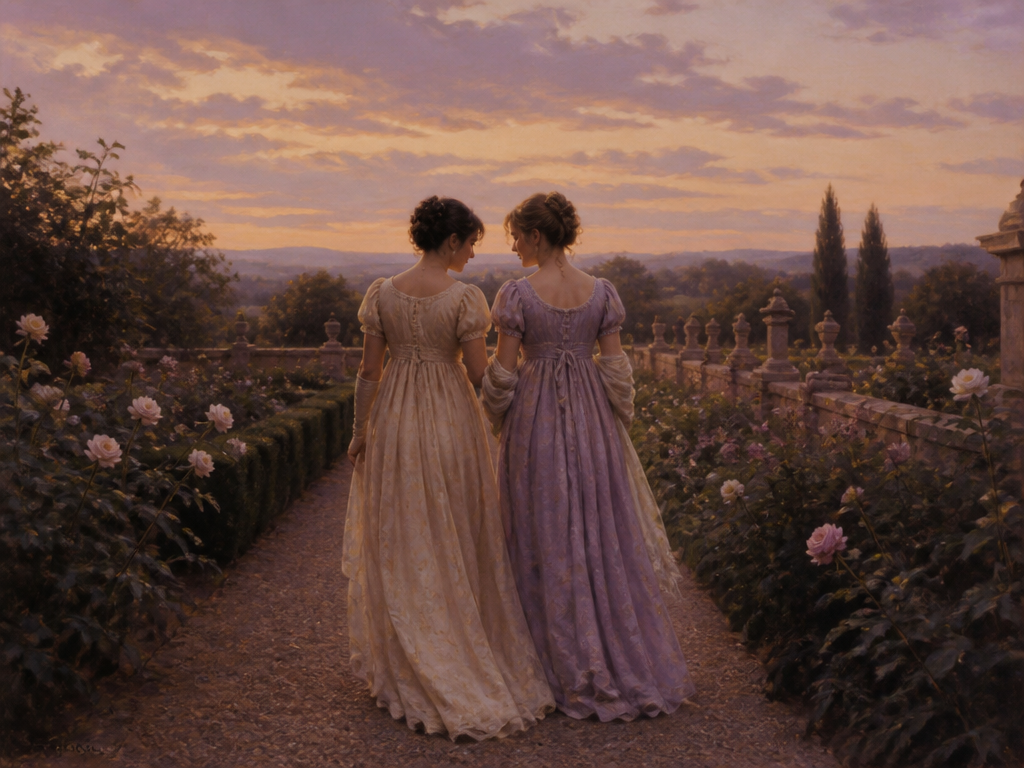
So give her the book. Through Harriet, Emma stays opaque — we see what she does, not what she means by it. Emma reaches for Harriet's hand without appearing to decide to, and doesn't let go, and Harriet has to sit there working out whether that's affection, memory, loneliness, or simply what Emma's hands have always done.
The reader gets to wonder along with her. And at some point the distinction stops mattering, which is the only honest ending available: they can find out what they are now without ever establishing what they were then.
Someone should write it. Not me — I've got my own two women to chase across impossible worlds, and they take up a great deal of room.
But the shape is irresistible. A famous, talkative heroine whose interior has been public property for two centuries, and a quiet one who has been looked at the whole time and never once got to look back.
Austen's word for what happened to that friendship was sink. Twenty years is a long time for something to sit at the bottom of a house.