Essay
The Cave Bear Problem at Chauvet
Before anyone painted the lions, somebody had to do something about the bears.
There are many questions you can ask about Chauvet Cave.
Why did people paint lions?
Why rhinoceroses?
Why were some images placed where they were?
Was the cave ceremonial? Symbolic? Spiritual? Narrative? Something for which we don't have a useful word?
All interesting questions.
But while I was writing Tell Me About the Lions, another one kept bothering me.
What did they do about the bears?
Because before anybody could paint anything, there was a fairly substantial logistical problem to solve.
The cave was already occupied.
By cave bears.
And cave bears were not small.
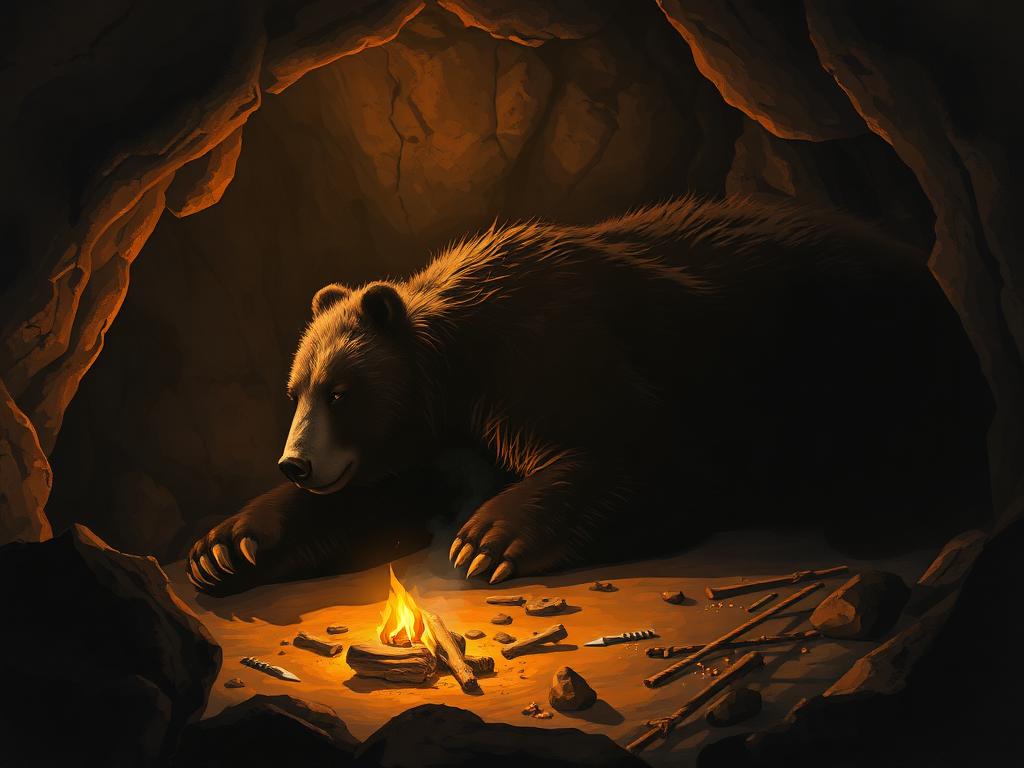
This seems like the sort of thing that should come fairly high on the planning agenda.
Pigment? Check.
Light source? Check.
Suitable wall for magnificent lion composition? Check.
Several hundred kilograms of bear somewhere ahead in complete darkness?
Ah.
The cave belonged to somebody else first
One of the things I love about Chauvet is that the human story is only part of it.
Evidence of bears is everywhere: bones, claw marks, hollows in the floor where animals bedded down. Humans were entering a place that other large mammals already used.
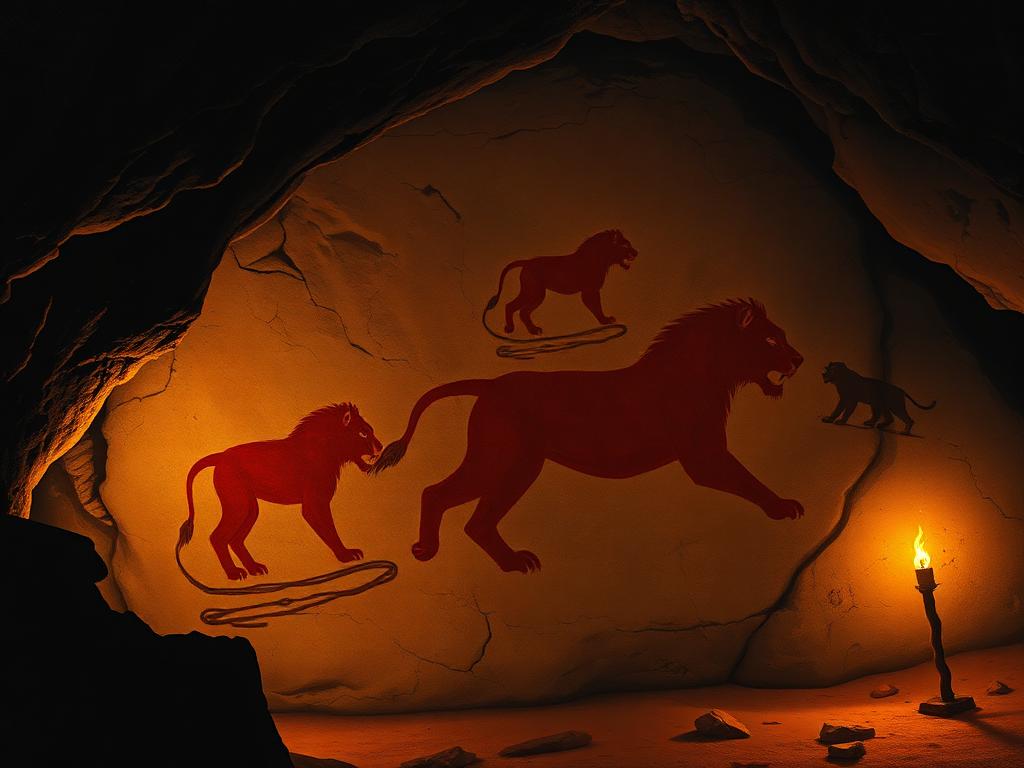
It's easy to forget how different their experience of the cave was from ours. We know it as Chauvet. We know the paintings are there. We have maps, lighting, walkways, scientific surveys and decades of research.
The people entering it thirty thousand years ago had none of that.
They had darkness. They had fire.
And potentially, somewhere in that darkness, they had bears.
In Tell Me About the Lions, Laura puts the problem rather simply:
“Before they made art, they had to solve the bears.”
It became one of my favourite little archaeological problems in the book — not because I think I've solved it, but because it's exactly the sort of question that can disappear when we move too quickly towards symbolism and ritual.
Before asking what the paintings meant, it might be worth asking how anyone managed to get there alive.
Laura has a theory
Laura thinks the answer might have been smoke.
Her reasoning is straightforward. If bears were occupying parts of the cave, walking towards them with a torch and hoping everyone remained calm seems a poor survival strategy.
So perhaps people encouraged them to leave.
With the original entrance open, Laura imagines fires positioned so that smoke was drawn deeper into areas used by bears.
Make the cave unpleasant. Let the bears leave. Then go in.
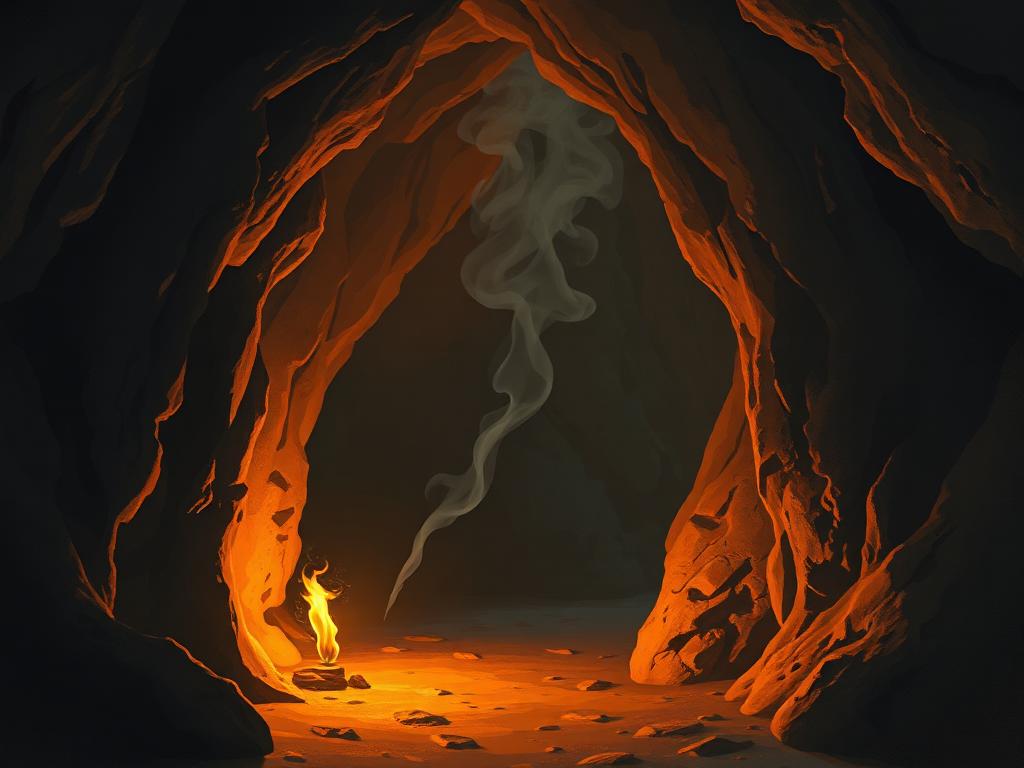
It's wonderfully practical.
It is also completely speculative.
What makes the idea interesting isn't that Laura can prove it. She can't. What interests her is a different question:
If they did this, what would it leave behind?
Now the speculation becomes potentially testable.
Would there be unusual concentrations of charcoal near bear hollows? Burns in places where an ordinary hearth makes little sense? Ash deposits associated with areas of bear activity? Patterns in the remains suggesting something had changed?
Anne immediately points out the problem.
People needed fire for illumination anyway.
Finding charcoal near evidence of bears would therefore prove very little by itself.
Which is exactly why archaeology is difficult.
Laura has another line in the novel that gets at it:
“We point to the charcoal under a panel and call it sacred fire. But proximity isn't proof. That's like saying because I'm standing next to a Ferrari, it's mine.”
Charcoal beneath a painting is evidence.
“Sacred fire” is an interpretation.
Likewise, bear hollow plus charcoal does not equal prehistoric bear-smoking operation.
But it might give you a question worth investigating.
Look for patterns. Compare locations. Try to distinguish different kinds of burning. Ask what else the hypothesis predicts.
And then see whether the evidence ruins your lovely idea.
Anne gives Laura the appropriate warning:
“Don't fall in love with it yet.”
Which is probably good archaeological advice in general.
Or perhaps they simply knew bears
There is, of course, another possibility.
Maybe we're making the whole thing too complicated.
The people who entered Chauvet lived in a world containing large and dangerous animals. They did not learn about cave bears from documentaries, museum skeletons or books.
They knew animals through experience.
They watched tracks. They understood seasons. They noticed behaviour. They probably possessed practical knowledge that would be far from obvious to someone arriving from the twenty-first century.
Perhaps they knew when bears were likely to be absent.
Perhaps they could tell immediately whether one had entered recently.
Perhaps they made noise before going deeper.
Perhaps they used fire or smoke.
Perhaps avoiding a bear in a cave involved some completely ordinary piece of knowledge that nobody needed to explain because everybody already knew it.
Or perhaps entering the cave really was dangerous.
We don't know.
And I'm happy leaving it there.
Because the interesting thing isn't choosing one answer and decorating it until it looks convincing. It's noticing that there was a problem in the first place.
The Paleolithic was practical before it was mysterious
When we look at Chauvet now, the paintings dominate everything.
Understandably.
But the people who made them still had to contend with the physical world.
They needed light and fuel. They had to negotiate uneven ground in darkness. They had to carry pigment and tools. They had to remember routes through chambers where a failed flame could make life suddenly much more interesting than anyone wanted.
And they had to share the landscape with animals considerably larger than themselves.
None of that makes the paintings less extraordinary.
For me, it does the opposite.
Someone didn't simply decide to draw lions on a wall. They had to get to the wall first.
That practical side of the Paleolithic became important in writing Laura. She is surrounded by theories about symbolism, ritual and meaning, but one of her instincts is to ask a much simpler kind of question:
How did this actually work?
How did they get the light in?
How did they move safely through the cave?
Why is material concentrated here rather than there?
And before somebody knelt in the darkness with charcoal and began drawing lions:
What on earth did they do about the bears?
Laura has her theory.
I rather like it.
Which is probably exactly when I should remember Anne's advice.
Don't fall in love with it yet.